
If you’re considering hair loss treatment in Japan, the first step is to match your specific hair thinning pattern with the right type of doctor. A dermatologist can help identify the underlying causes of hair loss, while an AGA clinic specializes in male pattern hair loss.
This choice is important because the oral medications approved in Japan for treating male pattern hair loss do not address all types of thinning. You will need to pay out of pocket for AGA (Androgenetic Alopecia) treatments at either type of clinic.
Ultimately, the decision comes down to the clinicians’ expertise and which option feels like the best fit for you.
Start with your hair loss pattern
Gradual, patterned thinning at the hairline or crown typically indicates male pattern hair loss, also known as androgenetic alopecia (AGA). If the thinning looks different, consult a dermatologist for an initial visit.
What male pattern hair loss usually looks like
Male pattern hair loss occurs gradually and follows a distinct pattern. The hairline may begin to recede at the temples, and the thinning at the crown may expand. Both areas can thin over months to years. Over time, hair follicles shrink, producing thinner hairs instead of abrupt hair loss.
When the pattern calls for a closer look
Certain types of hair loss can initially resemble male pattern baldness. However, symptoms like round bald patches, widespread thinning with a tender scalp, or redness and itching around the hair follicles may indicate a different condition.
In these cases, consult a dermatologist, who can examine the scalp and determine whether the cause is a skin disease, inflammation, or another type of hair loss.
How a dermatologist can help
A dermatologist is trained to diagnose conditions affecting the skin, hair, and nails. The Japanese Dermatological Association publishes clinical guidelines for male and female pattern hair loss in Japan. Dermatologists diagnose patterned thinning and can recommend appropriate treatments.
A diagnosis before treatment
The doctor may perform trichoscopy, a painless examination that views the scalp and hair under magnification. A 2024 systematic review of androgenetic alopecia found hair thickness variation in 94.07% of examined cases, a sign that is easier to see with magnification than with the unaided eye.1
The doctor may also gently pull a small tuft of hair to see whether too many come out. In healthy hair, a pull test usually removes two or fewer hairs.2
When a second condition overlaps with patterned thinning
Male pattern hair loss can occur alongside another condition. A single-center report of 29 men described a less obvious form of alopecia areata, an autoimmune type of hair loss, that looked like overall thinning but showed different signs under magnification.3
A dermatologist can look for signs and determine whether a biopsy or closer follow-up is needed.
What an AGA clinic offers
An AGA clinic is a private medical facility focused on male pattern hair loss. It can serve as a helpful starting point when the hair loss pattern is typical.
The exam comes first
At this type of clinic, a doctor examines your scalp before making a prescription.
Dermatologist or AGA clinic: choose by the pattern
If hair thinning occurs gradually, is patterned, and lacks redness or pain, either type of clinic can handle the initial visit. If the pattern is unclear, consult a dermatologist first.
Compare the two starting points
| Situation | Dermatologist | AGA clinic |
|---|---|---|
| Gradual thinning at the hairline or crown | Confirms the pattern and rules out other causes. | A doctor examines your scalp before prescribing. |
| Diffuse shedding with redness, itching, or pain | Checks the scalp for inflammation or another skin disease. | Not the first stop unless the diagnosis is already clear. |
| Round patches or sharply outlined bare areas | Can identify conditions that need a different treatment. | Start here only after a dermatologist has identified the cause. |
| An existing clear AGA diagnosis | Can provide ongoing care and monitoring. | Designed for continued AGA treatment and follow-up. |
This table does not rank the two types of clinics. Use it to avoid taking medication for male pattern hair loss when the underlying issue is different.
What to confirm at either clinic
Once you choose a starting point, make sure the doctor explains the diagnosis and treatment plan in a way you can understand. This is especially important if you are traveling from another country and will need a clear record for follow-up care back home.
Three points to check
- The diagnosis: whether you have male pattern hair loss or another condition.
- The treatment choices, expected follow-up, and possible side effects.
- How the clinic will monitor your progress and provide records for follow-up care.
During the consultation, ask about these points in simple language. You don’t need to know the medical terms; the doctor should explain your options clearly enough for you to make a decision.
Before you travel, write down when the thinning began, which areas changed first, and any itching, redness, or pain. These notes help the doctor compare your history with what appears on the scalp.
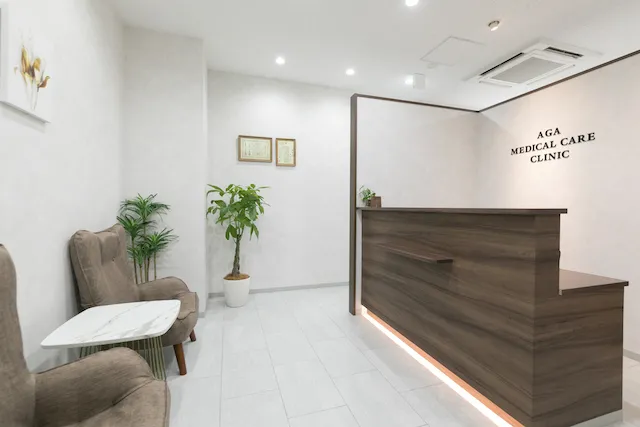
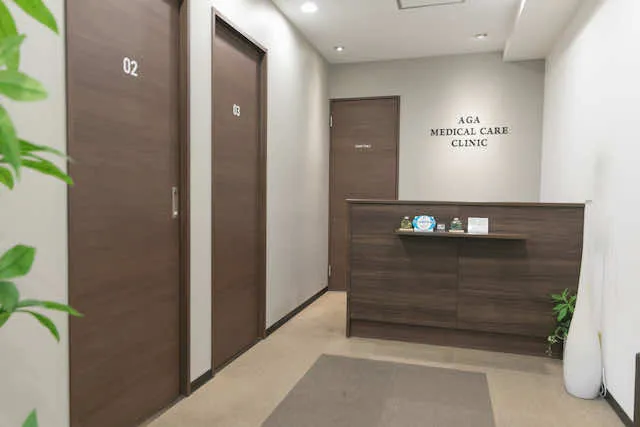
At AGA Medical Care Clinic, our doctors personally examine each patient before recommending treatment. Our clinics in Tokyo and Yokohama specialize in addressing male pattern hair loss.
Frequently asked questions
- Do I need to see a dermatologist before an AGA clinic in Japan?
-
No, not always. If your hair thinning is gradual and follows the typical patterns seen at the hairline or crown, you should consult a doctor at an AGA clinic for a diagnosis.
However, if the hair loss pattern is unclear or if your scalp is red, itchy, or painful, it’s best to start with a dermatologist.
- Are AGA medicines covered by Japanese health insurance?
-
Japan’s public health insurance does not cover oral medications for male pattern hair loss. You are responsible for paying for both the doctor’s visit and the prescription out of pocket, whether you see a dermatologist or an AGA clinic.
- What should I bring to the first appointment?
-
Please bring your passport, any records of previous hair loss diagnoses or treatments, and a brief note on when the thinning began and which areas were affected first. If you are currently taking any medications, please include that list as well.
- Can both a dermatologist and an AGA clinic prescribe the same hair loss medicines?
-
Yes, after diagnosing male pattern hair loss, a doctor at either type of clinic can prescribe approved oral medications specifically for this condition. The key step is obtaining the diagnosis.
References
1. Kuczara, A., Waśkiel-Burnat, A., Rakowska, A., Olszewska, M., & Rudnicka, L. (2024). Trichoscopy of Androgenetic Alopecia: A Systematic Review. Journal of Clinical Medicine, 13(7). https://doi.org/10.3390/jcm13071962
2. McDonald, K. A., Shelley, A. J., Colantonio, S., & Beecker, J. (2017). Hair pull test: Evidence-based update and revision of guidelines. Journal of the American Academy of Dermatology, 76(3), 472-477. https://doi.org/10.1016/j.jaad.2016.10.002
3. Starace, M., Hrvatin Stancic, B., Cedirian, S., Quadrelli, F., Pampaloni, F., Bruni, F., Alessandrini, A., Misciali, C., & Piraccini, B. M. (2025). Alopecia areata incognita in men masquerading as androgenetic alopecia: a case series of 29 patients in a single centre experience. Italian Journal of Dermatology and Venereology, 160(4), 309-313. https://doi.org/10.23736/S2784-8671.25.08170-8
Manabe, M., Tsuboi, R., Itami, S., Osada, S. I., Amoh, Y., Ito, T., Inui, S., Ueki, R., Ohyama, M., Kurata, S., Kono, T., Saito, N., Sato, A., Shimomura, Y., Nakamura, M., Narusawa, H., Yamazaki, M., & Drafting Committee for the Guidelines for the Diagnosis and Treatment of Male- and Female-Pattern Hair Loss (2018). Guidelines for the diagnosis and treatment of male-pattern and female-pattern hair loss, 2017 version. The Journal of Dermatology, 45(9), 1031-1043. https://doi.org/10.1111/1346-8138.14470
Workman, K., & Piliang, M. (2023). Approach to the patient with hair loss. Journal of the American Academy of Dermatology, 89(2S), S3-S8. https://doi.org/10.1016/j.jaad.2023.05.040
Blume-Peytavi, U., Blumeyer, A., Tosti, A., Finner, A., Marmol, V., Trakatelli, M., Reygagne, P., Messenger, A., & European Consensus Group (2011). S1 guideline for diagnostic evaluation in androgenetic alopecia in men, women and adolescents. The British Journal of Dermatology, 164(1), 5-15. https://doi.org/10.1111/j.1365-2133.2010.10011.x
Cortez, G. L., Hassun, K., Linhares, L. R. P., Florenço, V., Pinheiro, M. V. B., & Nascimento, M. M. D. (2025). Male androgenetic alopecia. Anais Brasileiros de Dermatologia, 100(2), 308-321. https://doi.org/10.1016/j.abd.2024.08.004
Griggs, J., Trüeb, R. M., Gavazzoni Dias, M. F. R., Hordinsky, M., & Tosti, A. (2021). Fibrosing alopecia in a pattern distribution. Journal of the American Academy of Dermatology, 85(6), 1557-1564. https://doi.org/10.1016/j.jaad.2019.12.056