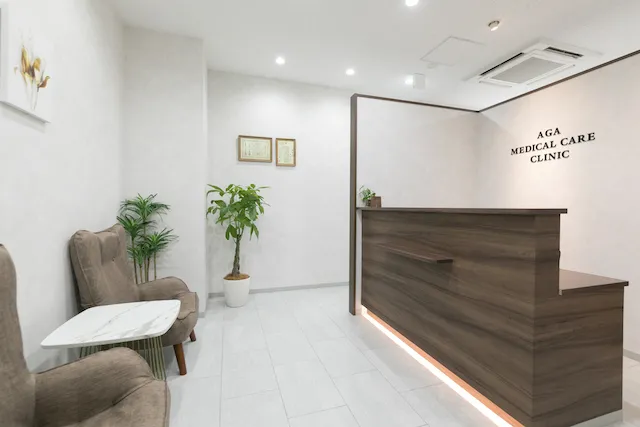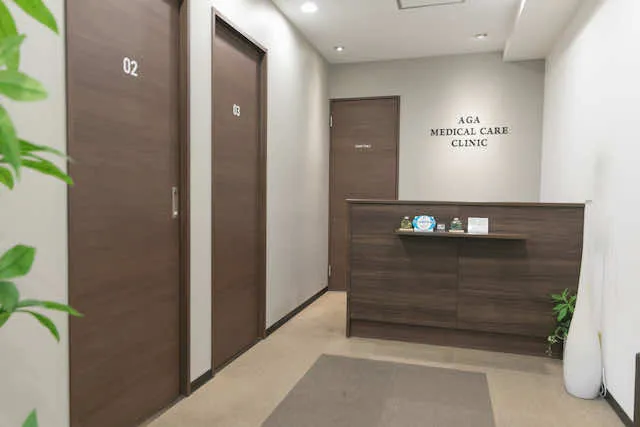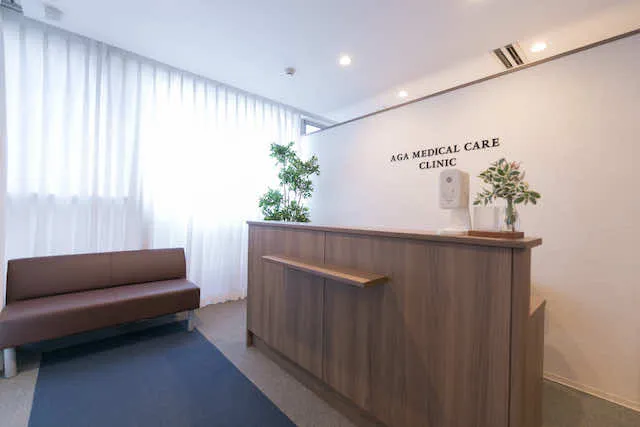
An AGA clinic in Japan is a doctor-led facility specializing in androgenetic alopecia (AGA), also known as male pattern hair loss. During your visit, a doctor will examine your scalp and may prescribe finasteride or dutasteride. We will schedule regular follow-up appointments to monitor treatment effectiveness.
Treatment is out-of-pocket, meaning that Japanese public health insurance does not cover the costs, and you will need to pay the full amount yourself.
If you are new to treatment in Japan, the process is simple: you make an appointment, meet with a doctor in person, and decide whether to start treatment that day or take time to consider your options.
What is an AGA clinic?
An AGA clinic is not a general hospital department; it specializes in male pattern hair loss, the most common type of hair loss.
How it differs from a general hospital
At a general hospital, the dermatology department treats the full range of skin, hair, and nail diseases. An AGA clinic narrows that range to male pattern hair loss.
The condition it treats
Androgenetic alopecia (AGA) starts after puberty and causes hair to become thinner and shorter over time, typically at the hairline and crown of the head.
The Japanese Dermatological Association strongly recommends oral finasteride, oral dutasteride, and topical minoxidil for men with male pattern hair loss. In Japan, finasteride and dutasteride require a doctor’s prescription, so you’ll need to visit a clinic.
Paying for AGA treatment
In Japan, the Ministry of Health, Labour and Welfare classifies the treatment for androgenetic alopecia (AGA) as a self-pay service. This means that public health insurance does not cover medications such as finasteride or dutasteride.
As a result, individuals have to pay out of pocket for every doctor’s visit and prescription, even if the medication is an approved prescription drug.
What self-pay does not change
The oral medicines stay prescription-only under self-pay care. At our clinic, a doctor examines you, explains the plan, and checks for side effects at follow-up visits.
Your first AGA clinic visit
The initial visit includes a medical exam and an overview of your options, so you can choose your next steps.
The steps at our clinic
During your first visit to our clinic, we will guide you through four steps.
- A private room right after you arrive, away from other patients
- Photos and a microscope view of your hair and scalp
- A doctor’s examination and explanation of suitable options
- A hair diagnostician who listens to your concerns and explains the plan
Starting treatment the same day or later
You can begin treatment on the first day of your visit. The clinic will conduct a blood test, and you will receive your oral medication to take home that same day.
If you prefer, you can have an examination and consultation only, go home, and decide later. Our doctors will not pressure you to start treatment immediately.
Prescriptions and follow-up visits
It takes several months to assess the effectiveness of prescription hair loss treatment. Your doctor will evaluate your progress during follow-up visits and may modify the plan accordingly.
The prescribing information for these medications in Japan indicates that their effectiveness should typically be evaluated after six months. If there is no improvement by that time, the doctor may decide to discontinue or reassess the medication.
Continue treatment to maintain the positive response, as stopping on your own can lead to a return of hair loss.
At each follow-up visit, our clinic takes new photos and performs a scalp exam. To ease your concerns and build trust, the same doctor stays with you. We repeat blood tests when your condition or possible side effects make them necessary.
During each follow-up visit, our clinic takes new photos and conducts a scalp examination. To help alleviate your concerns and build trust, the same doctor will be with you throughout the process. We will repeat blood tests as needed, based on your condition or any potential side effects.
What to confirm before you contact a clinic
Taking a moment to check your message before sending it can save time.
Three points to check first
Focus on three details that affect your safety and travel plan.
- A doctor examines your scalp and decides on the prescription.
- The clinic explains that treatment is self-pay and outlines the follow-up schedule.
- The clinic describes how you can continue care after you return to your home country.
From first inquiry to follow-up
Use the clinic’s contact form to ask only questions related to your travel plans. A short stay typically involves four steps.
| Step | What happens | What to decide |
|---|---|---|
| Before you travel | Check your entry status and the length of stay you can arrange. | Which dates fit an in-person visit. |
| Contact the clinic | Ask about English support and first-visit requirements. | Whether to book in Tokyo or Yokohama. |
| First visit | See the doctor, have hair and scalp images taken, and review the plan. | Start treatment the same day or decide later. |
| Follow-up | The clinic takes new photos and performs a scalp exam. | How long you can continue before returning home. |
The right clinic will begin your treatment only when the plan is clear and will explain how follow-ups work. Our doctors at the Tokyo and Yokohama clinics will discuss your options during the consultation.
Frequently asked questions
- Do I need Japanese public health insurance to visit an AGA clinic?
-
No, Japanese public health insurance does not cover AGA treatment. Visitors from other countries must also pay out of pocket. Please bring a passport to our clinic to verify your identity.
- Will the doctor prescribe medicine on the first visit?
-
If the doctor confirms AGA and the blood test supports starting treatment, you can receive oral medicine the same day. You do not have to start that day. You can go home and decide later.
- How often do I need to return to the clinic?
-
The doctor typically evaluates the results after six months. If the medication is effective, the treatment will continue to sustain the positive response. During follow-up visits, the clinic takes new photos and conducts a scalp examination, and you will usually see the same doctor each time.
Once your condition is stable, you can ask your doctor about online follow-up appointments. From overseas, these visits are for consultation only, as the clinic cannot ship medications.ne abroad.
- Can I communicate in English during the visit?
-
At our clinic, a doctor can examine you and explain the plan in English. Counselors may use prepared English materials and translation tools. You can also bring a family member or friend to act as your interpreter if you prefer.
References
Kanti, V., Messenger, A., Dobos, G., Reygagne, P., Finner, A., Blumeyer, A., Trakatelli, M., Tosti, A., Del Marmol, V., Piraccini, B. M., Nast, A., & Blume-Peytavi, U. (2018). Evidence-based (S3) guideline for the treatment of androgenetic alopecia in women and in men – short version. Journal of the European Academy of Dermatology and Venereology, 32(1), 11-22. https://doi.org/10.1111/jdv.14624
Liu, Y., Tosti, A., Wang, E. C. E., Heilmann-Heimbach, S., Aguh, C., Jimenez, F., Lin, S. J., Kwon, O., & Plikus, M. V. (2025). Androgenetic alopecia. Nature Reviews. Disease Primers, 11(1), 73. https://doi.org/10.1038/s41572-025-00656-9
Workman, K., & Piliang, M. (2023). Approach to the patient with hair loss. Journal of the American Academy of Dermatology, 89(2S), S3-S8. https://doi.org/10.1016/j.jaad.2023.05.040
Cortez, G. L., Hassun, K., Linhares, L. R. P., Florenço, V., Pinheiro, M. V. B., & Nascimento, M. M. D. (2025). Male androgenetic alopecia. Anais Brasileiros de Dermatologia, 100(2), 308-321. https://doi.org/10.1016/j.abd.2024.08.004
Manabe, M., Tsuboi, R., Itami, S., Osada, S. I., Amoh, Y., Ito, T., Inui, S., Ueki, R., Ohyama, M., Kurata, S., Kono, T., Saito, N., Sato, A., Shimomura, Y., Nakamura, M., Narusawa, H., Yamazaki, M., & Drafting Committee for the Guidelines for the Diagnosis and Treatment of Male- and Female-Pattern Hair Loss (2018). Guidelines for the diagnosis and treatment of male-pattern and female-pattern hair loss, 2017 version. The Journal of Dermatology, 45(9), 1031-1043. https://doi.org/10.1111/1346-8138.14470
Blume-Peytavi, U., Blumeyer, A., Tosti, A., Finner, A., Marmol, V., Trakatelli, M., Reygagne, P., Messenger, A., & European Consensus Group (2011). S1 guideline for diagnostic evaluation in androgenetic alopecia in men, women and adolescents. The British Journal of Dermatology, 164(1), 5-15. https://doi.org/10.1111/j.1365-2133.2010.10011.x