When you meet with your doctor, clearly express your goals by naming the specific area that concerns you, describing the appearance you want to maintain or regain, and indicating when you plan to assess your progress. This way, the doctor will clearly understand your objectives.
They also help the consultation process when describing cosmetic concerns in a second language, giving the clinic a fair starting point for comparing photos at each visit.
Turn your hopes into clear goals
A useful goal consists of three key components: first, the area you want to improve, second, the specific result you hope to achieve, and third, the time when you will review your progress. Write each part in clear and specific language instead of just saying, “I want more hair.”
In a survey across six countries involving men aged 25 to 49, approximately 75% of men seeking treatment expressed at least some concern, with one in four reporting dissatisfaction with their consultation, mainly due to the lack of specific proposals or answers.1
Break your goal into three parts
One line for each part is sufficient.
| Goal area | What to write | Example you can say |
|---|---|---|
| Area and appearance | Name the area and the look you want | “I want the crown to look fuller, and keeping the front hairline matters more than adding density behind it.” |
| Time frame | Pick a review month | “I will compare photos at six months, but I understand that keeping the hair I have may be the first result.” |
| Priority | State what would feel worthwhile | “The main issue is how my hair looks in photos, not a specific hair count.” |
Mention the situations that bother you
You can tell the doctor that your main concern is how your hair looks in photos, how windy or rainy weather affects your mood, or how often you avoid certain social situations.
A 2024 review of 37 studies found that male pattern hair loss moderately affected some quality-of-life measures, although average depression scores were similar to those of men without hair loss.2
Understanding the average doesn’t lessen your concern, and identifying the everyday situation you want to change helps the doctor set a goal.
What happens at the first visit
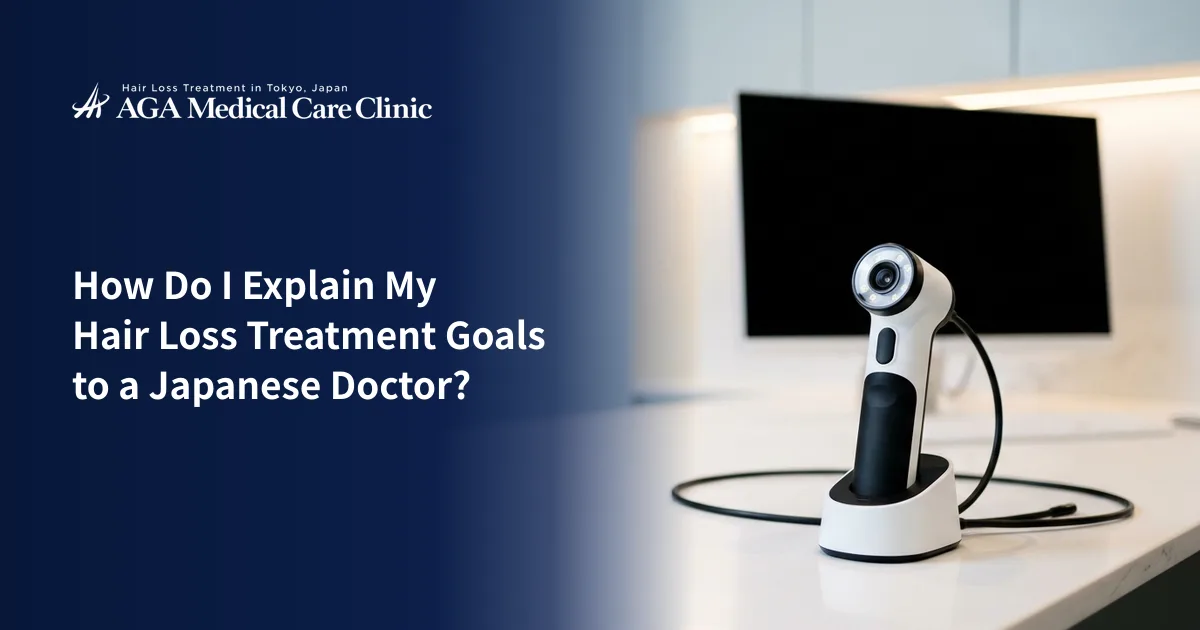
At our clinics, you will go directly to a private room to complete a questionnaire. Our team will take photographs of your hair (not your face) and examine your scalp using a microscope. A doctor will then assess your scalp, followed by a certified hair counselor who will discuss your concerns in detail.
Why the clinic repeats the photos
At your first visit, the clinic will photograph your hair, with follow-up images taken at each subsequent appointment. These matched photos help track hairline stability, density improvement, and crown consistency, providing more reliable insights than casual phone photos.
This method offers much more reliable information than casual phone photos.
What the doctor checks in person
The doctor examines your scalp and reviews the photos and microscope images to determine if the pattern matches male pattern hair loss.
Use your goals to set a realistic timeline
Schedule your first complete comparison at six months. Some men notice changes around three months, but most require about six months for the doctor to determine if treatment is effectively slowing the loss.
Why your starting point changes the target
The area you are treating influences the extent of visible change that is considered reasonable.
In a two-year photo study of men with crown thinning who took finasteride, younger men showed less hair loss in all four photographed areas, while older men showed reduced loss mainly in the crown and mid-scalp.3
If your hairline is your main concern, keeping it stable may be more useful than striving for dense regrowth.
Decide what change would feel worthwhile
A review of 60 surgical studies found that patient satisfaction depended on whether patients received what they expected, rather than the level of those expectations.4
The same concept applies to hair treatment: communicate your desired changes to the doctor, and let them advise on how realistic that goal is.
Month six is a checkpoint
The Japanese package insert for finasteride states that effects may be seen within three months; however, it usually takes six months to determine if the treatment is effectively slowing progression. Doctors may consider discontinuing treatment if no benefits are observed by then.
In a 10-year study of 118 men who continued finasteride, some did not show their first clear change until after one year.5 Schedule a review of the plan with your doctor in month six, and feel free to ask questions at any visit before then.
What to bring to your appointment
Please bring three or four recent photos along with a note that includes the date when your hair concern began and the primary issue you want to address first. A brief list will suffice; please ensure it doesn’t resemble a medical history form.
Take useful photos at home
Take clear photos of the front of your head, hairline, and crown from the same angle each time. Use dry hair and a plain background for easier comparisons later.
Make a three-line goal note
Write three lines about which area concerns you most, whether your priority is maintaining your current hair or adding density, and when you first noticed the change. Also, mention any hair products or treatments you have already tried.
- Recent photos of your front, hairline, and crown
- A note with when you first noticed the change and your top priority
- A list of products or medicines you have tried
The clinic will take its own photographs and examine your scalp under a microscope. Your phone photos should only show the initial change you noticed.
At our clinics in Tokyo and Yokohama, our doctor will listen to your goals and turn those brief notes into a comprehensive treatment plan, including when to evaluate progress. You can contact us through the pages below.
Frequently asked questions
- What if I only want to keep the hair I have?
-
Tell the doctor that maintenance is your main goal, not a visibly fuller head of hair. Photos taken at each visit then show whether those areas stay stable.
- Do I need to bring photos to the first visit?
-
You do not need them, but a few dated photos help show what you noticed first. Because the clinic also takes its own photos, your home shots are a starting point, not a requirement.
- Can I mention that the problem is mostly social?
-
Yes, and it helps to mention the specific situation, such as photos, rain, or bright office lighting. That detail helps the doctor understand when hair loss bothers you and what you hope treatment will improve.
- What if my goal changes after six months?
-
You and your doctor can revise the goal at any review. Review your photos and notes with the doctor, and explain how your goals have changed. Then set a new checkpoint to keep the plan aligned with your priorities.
References
1. Cash, T. F. (2009). Attitudes, behaviors, and expectations of men seeking medical treatment for male pattern hair loss: results of a multinational survey. Current Medical Research and Opinion, 25(7), 1811-20. https://doi.org/10.1185/03007990903005201
2. Frith, H., & Jankowski, G. S. (2024). Psychosocial impact of androgenetic alopecia on men: A systematic review and meta-analysis. Psychology, Health & Medicine, 29(4), 822-842. https://doi.org/10.1080/13548506.2023.2242049
3. Olsen, E. A., Whiting, D. A., Savin, R., Rodgers, A., Johnson-Levonas, A. O., Round, E., Rotonda, J., Kaufman, K. D., & Male Pattern Hair Loss Study Group (2012). Global photographic assessment of men aged 18 to 60 years with male pattern hair loss receiving finasteride 1 mg or placebo. Journal of the American Academy of Dermatology, 67(3), 379-86. https://doi.org/10.1016/j.jaad.2011.10.027
4. Waljee, J., McGlinn, E. P., Sears, E. D., & Chung, K. C. (2014). Patient expectations and patient-reported outcomes in surgery: a systematic review. Surgery, 155(5), 799-808. https://doi.org/10.1016/j.surg.2013.12.015
5. Rossi, A., Cantisani, C., Scarnò, M., Trucchia, A., Fortuna, M. C., & Calvieri, S. (2011). Finasteride, 1 mg daily administration on male androgenetic alopecia in different age groups: 10-year follow-up. Dermatologic Therapy, 24(4), 455-61. https://doi.org/10.1111/j.1529-8019.2011.01441.x